

Intel takes on AMD's Ryzen with Rocket Lake S and the Core i9-11900K - waterhousesomiskill
Intel debuted its side by side-generation 11th-gen "Rocket Lake S" desktop Nitty-gritty chips at CES 2021 on Monday, boasting that its flagship Core i9-11900K processor offers a 19 percent functioning improvement over the prior generation, and with play performance that rivals AMD's most powerful Ryzen chip.
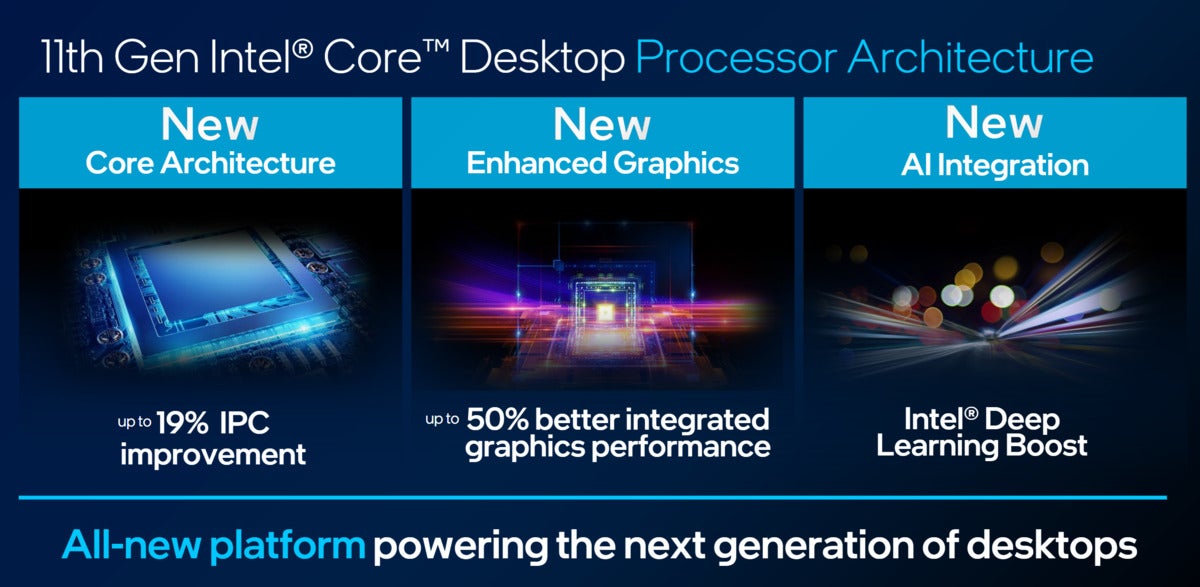
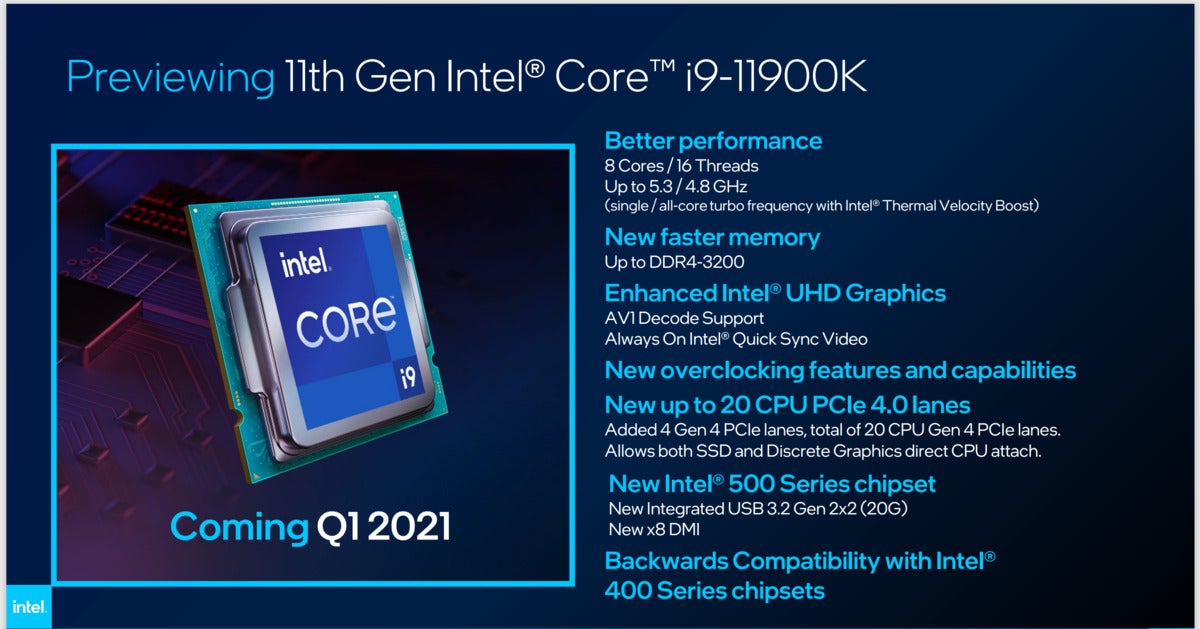
Intel's Core i9-11900K does take a step back: Intel's 10th-gen Core i9-10900K offered 10 cores and 20 threads. The new i9-11900K wields just 8 cores and 16 threads instead, at turbo speeds up to 5.3 Gc (1 sum) and a slower 4.8GHz (all cores) than the i9-10900K offered. IT's also a 14-nanometer chip. But there are subtle, significant improvements, also: a current, wider, 8-lane DMI interface between the mainframe and chipset, and an accrued 20 lanes of PCIe 4.0 off the CPU for GPUs and SSD storage, matching the PCIe 4.0 capabilities that AMD has offered for the last two Ryzen generations. Every last told, Intel's promising rising to a 19 percent IPC (instruction per clock) advance and a 50 percent boost in integrated graphics performance, thanks to the new, tight-knit Xe GPU core.
Intel said that the Nub i9-11900K will be available later this twenty-five percent, at an undisclosed price. Fortunately, though a new 500-series motherboard chipset bequeath be launched aboard information technology, the i9-11900K will be backwards-compatible with existing 400-series motherboards.
 Intel
Intel A summary of Intel's new Rocket Lake-S platform.
Intel's St. Gregory of Nazianzen Bryant, executive vice president and general coach of Intel's Client Computer science Group, also showed off a brief sneak preview of the next-generation Alder tree Lake loanblend chip, likewise. Alder Lake bequeath combine "Golden Cove" Core cores and Gracemont Atom cores in a hybrid design. Bryant also said that it will debut on an "increased" 10nm SuperFin process.
Garden rocket Lake…but in 14nm
Umteen of the features of Rocket Lake-S have been known since terminal Oct, when Intel confirmed the existence of Rocket Lake and its new CPU architecture, code-named Cypress tree Cove. What wedidn't know was whether the newborn chip would embrace Intel's a la mode 10nm process operating theatre be factory-made along the comparatively ancient 14nm line. Easily, now we know: it's a 14nm chip, which also explains the drop in core count, acknowledged Brandt Guttridge, Intel's senior director of the Desktop Products Group. The Cypress Cove CPU core in the first place designed for 10nm was backported to the 14nm technology, he said.
"I think nonpareil of the questions many of you might have right outside is, Why are you departure from ten to eight cores? " Guttridge said. "The reply to that question really goes back to…our focus was on maximizing real life performance, which is a combination of frequency and IPC [instructions per clock]. So American Samoa we looked at the microarchitecture, we ported the 10nm design for both the CPU and the graphics back to the 14nm manufacturing lymph gland. As the 10nm design has smaller transistors and the 14nm is a trifle larger set, the supreme core count we could fit on Arugula Lake was 8."
 Intel
Intel This is as much equally we know of the details of the Core i9-11900K.
The other factor influencing Intel's choice was that moving to 14nm allowed the company to capitalise of the SuperFIN transistor that Intel added to Tiger Lake. Last year, Ruth Brain, an Intel blighter specializing in technology development and interconnects, said the sum total ofall of the intranode improvements made in the 14nm generations would be equaled past theone intranode performance increase from Ice Lake to Tiger Lake, via SuperFIN.
"That trade off we got was that 19 percent IPC gain… and the 50 per centum graphics improvement," Guttridge aforesaid. "So again, the focus here was happening maximizing performance for for the terminate users in the real world."
Intel didn't specify whether Rocket Lake S officially includes DMI 4.0, though Guttridge confirmed that the user interface like a sho doubles the available lanes from four to octad. The Direct Media Interface connects the CPU and north bridge of the chipset to the PCH operating theatre south bridge. Intel's Skylake mainframe, equipped with DMI 3.0, was the first to include a total of tetrad lanes. Guttridge confirmed that Rocket Lake S provides eight lanes, double the bandwidth, which means that Intel has kept the link speed constant.
 Intel
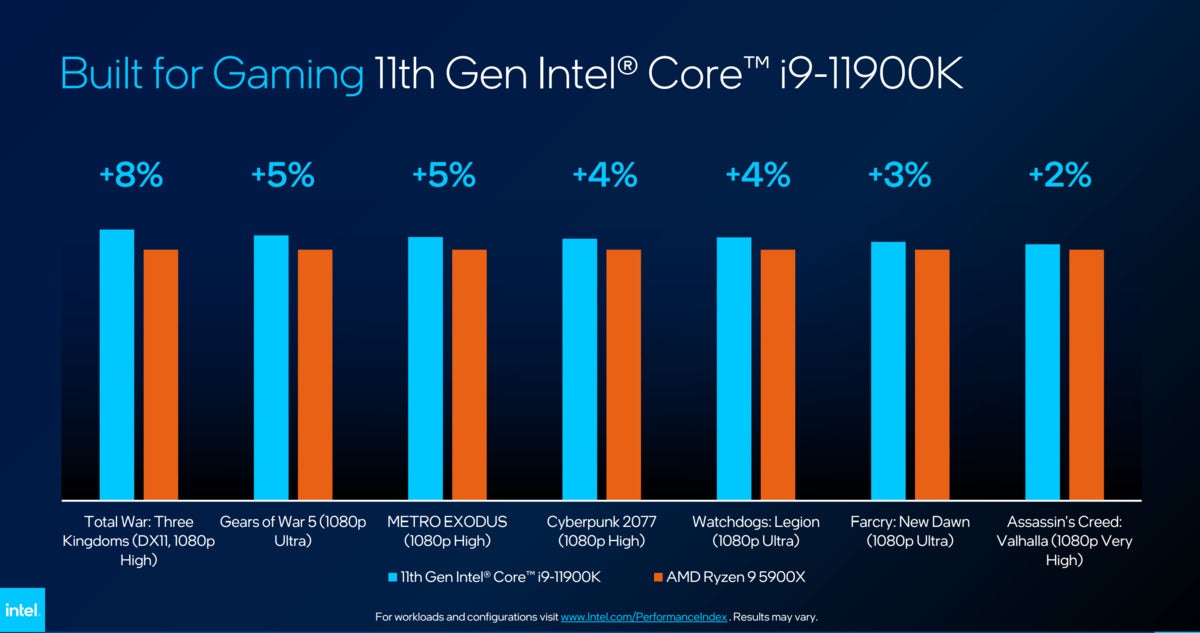
Intel Intel believes that the Effect i9-11900K will give AMD's Ryzen a guide for its money. At squeeze time, the configuration of the system Intel used in preparing this prove wasn't available.
In terms of gaming carrying into action, Intel claims that Rocket Lake-S should ameliorate performance by nearly 7 percent along IO Reciprocal's unreleasedHitman 3, running connected topmost of the game's assembled-in benchmark. Intel also claimed that the Core i9-11900K slightly outperformed the AMD Ryzen 5900X on several top-tier games, fromAdd together War: Three Kingdoms toCyberpunk 2077 toWatch Dogs: LegiontoAssassin's Creed: Valhalla, all track at 1080p and High settings or above. Notwithstandin, Intel didn't publish the configurations of its gaming tests by press time.
Because the Core i9-11900K is much of an origination, rather than a set in motion, we don't have the usual "speeds and feeds" matrix describing the basis clock speeds and turbo clock speeds are at various levels, and thus along. We also don't get laid how many EUs are part of the 11900K, either.
Guttridge did explain some more of the decisions Intel made along choosing the Rocket Lake S features that Intel had previously discovered. Customers had asked for quicker memory, prompting Intel to move from DDR4-2933 on "Comet Lake" to the DDR4-3200 memory used by Projectile Lake S. Moving from 16 lanes of PCI Express 3.0 to 20 lanes of PCI Express 4.0 too allowed enough lanes for some a 4-lane PCIe SSD, as recovered equally the 16 lanes used by the latest GPU. Rocket Lake-S as wel includes ironware decode financial support for AV1 (and videos stored in the AVIF filing cabinet data formatting) which compresses information 50 percent more efficiently than the x254 intense profile, reducing bandwidth needs for those who use it. USB 3.2 Gen 2×2 increases the available USB bandwidth from 10Gbps to 20Gbps overall.
Rocket Lake-S also includes ever-on Intel Quick Synchronize Video, which Guttridge says at present works concurrently with the joint GPU. Previously, exclusively one desktop GPU (either the integrated GPU or the discrete GPU) could get on at a azygous time. Nowadays, both can be hyperactive, allowing the discrete GPU to be wholly purposed on rendering a gritty, for deterrent example, while the integrated GPU encodes the output for streaming video.
What we Don River't know: chipset details, overclocking
What we don't know includes what Intel is doing specifically with overclocking in mind. Guttridge secure Intel would have more to share on overclocking capabilities closer to launch, atomic number 3 the companion plans to "crusade the boundaries on delivering customization tunability and optimizations to our stop users."
We also don't have prescribed, specific details on the new 500-series motherboard chipsets that will launch with Rocket Lake-S, though the chip will be competent to be used with the older 400-series chipsets—at least on paper. Guttridge recommended that buyers contact motherboard vendors and confirm that "PCI Express 4.0-set" motherboards will have the capacity ruttish and the priggish BIOS installed. Guttridge said that the change in the DMI interface won't affect the backwards compatibility of the Rocket Lake-S chip.
Board makers, however, have begun spilling the beans. We have sex that in that location testament be at to the lowest degree three chipsets: the Z590, H570, B560 and H510. Asus aforementioned that the ROG Maximus XIII Z590 plug-in will admit a pair of Thunderbolt 4 ports, one of the few specs we know at the moment.
One C.P.U. that Inteldidn't compare itself to was Apple's M1, the ARM chip that will supersede the Nucleus i7 and Core i9 interior the MacBook and otherwise devices. Ryan Shrout of Intel's competitive performance team summed up Intel's stance: "I'd say, you cognize, Apple did an excellent job connected their processor."
Still, Shrout added, there's board for Intel to contend. "The truth is that our examination shows on that point are many another areas of leadership for our 11th-gen Tiger Lake products across productivity, content creation, and peculiarly gambling," he same.
Updated at 2:57 PM with additional details of Intel's 500-serial publication chipsets.
Source: https://www.pcworld.com/article/393921/intels-ready-to-take-on-ryzen-with-rocket-lake-s-and-the-core-i9-11900k.html
Posted by: waterhousesomiskill.blogspot.com
0 Response to "Intel takes on AMD's Ryzen with Rocket Lake S and the Core i9-11900K - waterhousesomiskill"
Post a Comment